
Inference built for conversation
The fastest voice AI.
- People
- 0.21 s
- Dispatchino
- 0.42 s p50
- ElevenLabs
- 1.27 s mean
Our inference is built from the ground up for live calls, so Dispatchino answers 420 ms after the caller stops talking, at p50. No dead air: callers hear someone keeping up, not a machine catching up.
[01]Against the field
Cascaded voice AIThe others still wait.
Most voice AI runs as a cascade: speech to text, then a language model, then a voice. On a public benchmark of those platforms, the fastest took 1.27 seconds on average to answer: four times the 300 ms rule, and six times a human pause.
People: the mean gap between turns across ten languages, Stivers et al., PNAS 2009 (opens in a new tab) (208 ms). The 300 ms rule is the industry’s rule of thumb for a pause that still feels natural. Cascaded platforms: mean response time from Cekura’s public voice agent benchmark (opens in a new tab), v1, updated 22 Oct 2026. Its speech-to-speech models are left out. Dispatchino: 420 ms p50 from the caller’s last sound to the agent’s first, on internal benchmarks. Different tests, not a head-to-head run.
[02]Response time
Caller’s last sound to AI’s first420MS P50
People answer each other in about 200 ms. Past 300 ms, the industry’s rule of thumb goes, a pause starts to feel wrong. Dispatchino lands just past it. ElevenLabs takes three times as long, and callers hear every millisecond of it.
Internal benchmarks · p50ElevenLabs · Cekura mean
[03]Feel the gap
Sound onHalf a second is everything.
Hold the button and say anything out loud. Let go, and the reply comes back after 420 ms, our p50. Then switch to ElevenLabs’ 1,270 ms mean and try again. You’ll hear why callers hang up.
Hold to talk
0ms
Sound on. Nothing is recorded.
[04]Why speed
Most voice AI leaves a gap after every sentence. Callers hear it.
Callers will forgive one pause. Nobody sits through a second of silence after every sentence. Past that, it stops being a conversation and starts feeling like being on hold.
- 01
No “hello?”
The reply lands in the natural pause between turns. Callers don’t wonder if the line dropped, and they don’t talk over the agent.
- 02
Built for the phone
Made for live phone audio and real callers, who interrupt, trail off and change their minds mid-sentence.
- 03
Proven where slow loses
It runs our freight agent’s live negotiations with brokers, where a second of silence costs the load.
[05]Built on the phone
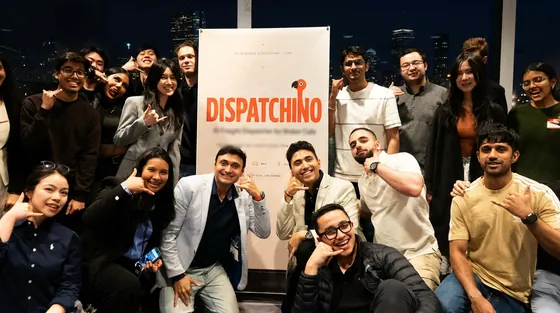
a16z Tech WeekTested on freight brokers, who hang up on slow.
We built this for our AI dispatcher, which negotiates truck loads with brokers on live calls. A second of dead air loses the load. At a16z Tech Week, a room full of people tried to break it.
 Official a16z Tech Week event(opens the event page in a new tab)Featured on ACMi News·Local news(opens in a new tab)
[06]Events
Recently
Cafe Compute
An evening of building with fast inference, presented by Cerebras. We’re hosting it, and building the fastest voice AI model.
[07]Questions
Asked often.
How fast is it, exactly?
On internal benchmarks, Dispatchino starts answering 420 ms after the caller’s last sound at p50. ElevenLabs, the fastest cascaded platform on Cekura’s public benchmark, averages 1,270 ms.
What are you measuring?
The silence a caller hears: from the last sound they make to the first sound of the reply, on the call itself. Not the time until a model starts producing text, which leaves out most of the wait.
How does it work?
That part we keep to ourselves. Book a demo and we’ll show you what it does on your calls.
Where has it been tested?
On live freight calls, where our AI dispatcher negotiates loads with brokers, and in front of a room at a16z Tech Week, where people tried hard to break it.
Can it work with my voice agent?
Tell us what your agent does on the phone and what it runs on. We’ll tell you plainly what we can do for it.
[08]Contact
Put it on your calls.
Tell us what your agent does on the phone. We’ll show you how fast it can answer.
Book a demo
Email us with
Gmail (opens in a new tab)Outlook (opens in a new tab)Your email app